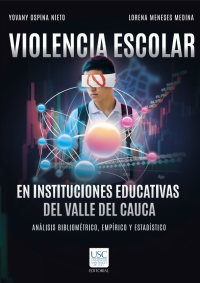
Violencia Escolar en Instituciones Educativas del Valle del Cauca: Análisis Bibliométrico, Empírico y Estadístico
Palabras clave:
Violencia escolar, conflicto escolar, acceso escolar, Valle del Cauca, prácticas restaurativas, análisis bibliométrico, intervención educativaSinopsis
El libro "Manifestaciones de Violencia Escolar", de Yovany Ospina Nieto y Lorena Meneses Medina, es una obra que analiza de manera rigurosa y detallada uno de los desafíos más apremiantes en los entornos educativos: la violencia escolar. A lo largo de tres capítulos, los autores desentrañan las múltiples manifestaciones de este fenómeno, desde el conflicto hasta el acoso y la violencia, y exploran sus impactos emocionales, sociales y académicos en los estudiantes. El texto se apoya en una base sólida de investigación que combina análisis bibliométricos y metaanálisis, lo que permite identificar tendencias globales y regionales, así como patrones recurrentes de agresión en diferentes contextos escolares.
El primer capítulo se centra en establecer un marco teórico y metodológico, utilizando un análisis bibliométrico para identificar las relaciones entre conflicto, acoso y violencia escolar. Los autores ofrecen una visión amplia de cómo estas dinámicas están interconectadas y las principales variables que las alimentan, como las diferencias culturales, las políticas escolares y las características individuales de los estudiantes. Este apartado no solo destaca los factores que perpetúan estas problemáticas, sino que también examina las estrategias que se han implementado en diferentes contextos para abordarlas de manera efectiva.
En el segundo capítulo, se presenta un estudio de campo realizado en escuelas del Valle del Cauca, donde se identifican las formas más frecuentes de violencia escolar y las prácticas restaurativas utilizadas para contrarrestarlas. Este análisis ofrece una perspectiva contextual que resalta la influencia del entorno sociocultural y económico en la configuración de la violencia. Además, pone en evidencia la importancia de involucrar a todos los actores de la comunidad educativa —estudiantes, docentes y familias— para generar soluciones sostenibles y mejorar el clima escolar.
Finalmente, el tercer capítulo utiliza herramientas de estadística multidimensional para evaluar el impacto de la violencia escolar en el rendimiento académico y las emociones de los estudiantes. Los resultados de este análisis subrayan la urgencia de implementar políticas educativas integrales que prioricen la prevención y el manejo adecuado de conflictos. El libro concluye con una reflexión sobre la necesidad de adoptar enfoques multidisciplinarios que no solo busquen mitigar la violencia, sino también promover la formación de ciudadanos capaces de convivir en entornos respetuosos y colaborativos.
Descargas
Los datos de descarga aún no están disponibles.
Biografía del autor/a
Yovany Ospina Nieto, Universidad Santiago de Cali
Magister en Educación y Desarrollo Humano, licenciado en Filosofía y doctor en Administración de Negocios. Miembro del grupo de investigación Humanidades y Universidad y profesor a tiempo completo en la Universidad Santiago de Cali. Los temas que abordan sus líneas de investigación son la convivencia en las escuelas, la educación para la paz, el desarrollo ciudadano y ético, así como los procesos educativos en entornos escolares. Durante su carrera en la educación superior, ha liderado y publicado múltiples proyectos de investigación que tienen relación con los temas tratados en este trabajo.
 https://orcid.org/0000-0001-6578-3403
 yovanyospina00@usc.edu.co
Lorena Meneses Medina, Universidad Santiago de Cali
Comunicadora Social y Magíster en Comunicación. Docente de la Universidad Santiago de Cali e integrante del grupo de investigación GISOHA. Sus intereses investigativos se orientan al estudio de la comunicación estratégica, la publicidad, la comunicación organizacional y la producción de contenidos en contextos sociales e institucionales. Ha participado en procesos académicos y proyectos de investigación relacionados con estrategias de comunicación y gestión de mensajes en distintos escenarios organizacionales y comunitarios.
https://orcid.org/0009-0005-2767-1263
lorena.meneses00@usc.edu.co
Referencias
Bandura, A. (1977). Teoría del aprendizaje social. Madrid: Espasa-Calpe. https://nanopdf.com/download/teoria-del-aprendizaje-social-albert-bandura_pdf
Bandura, A. (1977). Self-efficacy: toward a unifying theory of behavioral change. Psychological Review, 84 (2), 191-215. Recuperado de http://www.uky.edu/~eushe2/Bandura/Bandura1977PR.pdf
Berger, C., Álamos, P., Milicic, N. y Alcalay, L. (2013). Rendimiento académico y las dimensiones personal y contextual del aprendizaje socioemocional: evidencias de su asociación en estudiantes chilenos. Universitas Psychologica, 13(2), 627–638. https://psycnet.apa.org/record/2015-09085-018
Borgobello, A., Pierella, M. P., & Pozzo, M. I. (2018). Uso de cuestionarios en investigaciones sobre universidad: análisis de experiencias desde una perspectiva situada. https://rephip.unr.edu.ar/server/api/core/bitstreams/73b903ac-3b6a-4ee9-9512-005085d72530/content
Bradshaw, C. P., Sawyer, A. L., & O'Brennan, L. M. (2018). A social disorganization perspective on bullying-related attitudes and behaviors: The influence of school context. American Journal of Community Psychology, 61(1-2), 78-92. https://pubmed.ncbi.nlm.nih.gov/19333749/
Bronfenbrenner, U. (2005). Making human beings human: bioecological perspectives on human development. California: Sage Publications https://books.google.com.ec/books?id=fJS-Bie75ikC&printsec=frontcover#v=onepage&q&f=false
Bronfenbrenner, U. & Morris, P. A. (2007). The bioecological model of human development. Em Damon, W. & Lerner, R. M. (Eds.). Handbook of child psychology, Vol. 1: Theoretical models of human development (993-1028). New York: John Wiley. https://onlinelibrary.wiley.com/doi/abs/10.1002/9780470147658.chpsy0114
Buhs, E. S., Ladd, G. W., & Herald, S. L. (2018). Peer exclusion and victimization: Processes that mediate the relation between peer group rejection and children's classroom engagement and achievement? Journal of Educational Psychology, 98(1), 1-13. https://doi.org/10.1037/0022-0663.98.1.1
Chen, J. K., & Wei, H. S. (2011). The impact of school violence on self-esteem and depression among Taiwanese junior high school students. Social indicators research, 100, 479-498. https://link.springer.com/article/10.1007/s11205-010-9625-4
Chen, J. K., Yang, B., Wang, L. C., Chang, C. W., & Lin, C. Y. (2023). Is psychological distress a risk factor or an outcome of school Violence and cyberbullying perpetrated by adolescents? A short-term longitudinal panel study. Journal of interpersonal violence, 38(15-16), 9215-9238. https://doi.org/10.1177/0886260523116324
Creswell, J. W. (2014). Research Design: Qualitative, Quantitative and Mixed Methods Approaches (4th ed.). Thousand Oaks, CA: Sage. https://www.amazon.com/Research-Design-Qualitative-Quantitative-Methods/dp/1452226105
Cronbach, L. J. (1951). Coefficient alpha and the internal structure of tests. psychometrika, 16(3), 297-334. https://link.springer.com/article/10.1007/bf02310555
Deci, E. L., y Ryan, R. M. (1985). The general causality orientations scale: Self-determination in personality. Journal of Research in Personality, 19, 109-134. https://www.sciencedirect.com/science/article/abs/pii/0092656685900236
Deci, E. L., y Ryan, R. M. (2000). The "what" and "why" of goal pursuits: Human needs and the self determination of behaviour. Psychological Inquiry, 11, 227-268. https://doi.org/10.1207/S15327965PLI1104_01
Dorio, N. B., Clark, K. N., Demaray, M. K., y Doll, E. M. (2020). School climate counts: A longitudinal analysis of school climate and middle school bullying behaviors. International journal of bullying prevention, 2(4), 292-308. https://doi.org/10.1007/s42380-019-00038-2.
Dragani?, M., Grbovi?, S., & Adži? Ze?evi?, A. (2024). The Incidence and Forms of Cyberbullying and the Connection Between Cyberbullying and Self-Esteem Among High School Students in Montenegro. Sage Open, 14(1). https://doi.org/10.1177/21582440241239124
Espelage, D. L., Hong, J. S., Rinehart, S., & Doshi, N. (2016). Understanding types, locations, & perpetrators of peer-to-peer sexual harassment in US middle schools: A focus on sex, racial, and grade differences. Children and youth services review, 71, 174-183, https://doi.org/10.1016/j.childyouth.2016.11.010
Hymel, S., & Swearer, S. M. (2015). Four decades of research on school bullying: An introduction. American Psychologist, 70(4), 293-299. https://psycnet.apa.org/doiLanding?doi=10.1037%2Fa0038928
Jairam, D., & Kahl, D. H. (2012). Navigating the doctoral experience: The role of social support in successful degree completion. International Journal of Doctoral Studies, 7, 311–329. doi: https://doi.org/10.28945/1700
Kowalski, R. M., Giumetti, G. W., Schroeder, A. N., & Lattanner, M. R. (2018). Bullying in the digital age: A critical review and meta-analysis of cyberbullying research among youth. Psychological Bulletin, 140(4), 211-272. https://psycnet.apa.org/doiLanding?doi=10.1037%2Fa0035618
Kwan, I., Dickson, K., Richardson, M., MacDowall, W., Burchett, H., Stansfield, C., ... y Thomas, J. (2020). Ciberacoso y salud mental de niños y jóvenes: un mapa sistemático de revisiones sistemáticas. Ciberpsicología, comportamiento y redes sociales, 23 (2), 72-82. https://www.liebertpub.com/doi/full/10.1089/cyber.2019.0370
Lidberg, J., Berne, S., & Frisen, A. (2023). Challenges in emerging adulthood related to the impact of childhood bullying victimization. Emerging Adulthood, 11(2), 346-364. https://journals.sagepub.com/doi/pdf/10.1177/21676968211051475
Olweus, D. (2016). School bullying: Development and some important challenges. Annual Review of Clinical Psychology, 9, 751-780. https://doi.org/10.1146/annurev-clinpsy-050212-185516
Otzen, T, & Manterola, C. (2017). Técnicas de Muestreo sobre una Población a Estudio. International Journal of Morphology, 35(1), 227-232. https://dx.doi.org/10.4067/S0717-95022017000100037
Pelfrey WV, Weber N. (2014). Hablar de tonterías y el juego del teléfono: conceptualización del acoso cibernético con jóvenes de la escuela secundaria y preparatoria. Journal of Youth Studies, 17(3), 397–414. https://doi.org/10.1080/13676261.2013.830702
Smith, P. K., & Thompson, F. (2017). Preventing and tackling bullying: An international perspective. Educational Psychology Review, 29(1), 37-59. https://doi.org/10.1007/s10648-016-9371-y
Smith, P. K., Mahdavi, J., Carvalho, M., Fisher, S., Russell, S., & Tippett, N. (2008). Cyberbullying: Its nature and impact in secondary school pupils. Journal of child psychology and psychiatry, 49(4), 376-385. https://acamh.onlinelibrary.wiley.com/doi/full/10.1111/j.1469-7610.2007.01846.x
Smokowski, P. R., Evans, C. B., & Cotter, K. L. (2014). The differential impacts of episodic, chronic, and cumulative physical bullying and cyberbullying: the effects of victimization on the school experiences, social support, and mental health of rural adolescents. Violence & Victims, 29(6). 10.1891/0886-6708.vv-d-13-00076
Tokunaga, R. S. (2010). Following you home from school: A critical review and synthesis of research on cyberbullying victimization. Computers in human behavior, 26(3), 277-287. https://doi.org/10.1016/j.chb.2009.11.014
Ttofi, M. M., & Farrington, D. P. (2017). Effectiveness of school-based programs to reduce bullying perpetration and victimization: A systematic and meta-analytic review. Journal of Experimental Criminology, 13(4), 439-465. https://link.springer.com/article/10.1007/s11292-010-9109-1
Varela, J. J., Savahl, S., Adams, S., y Reyes, F. (2020). Examining the relationship among bullying, school climate and adolescent well-being in Chile and South Africa: A cross cultural comparison. Child Indicators Research, 13(3), 819-838. https://doi.org/10.1007/s12187019-09648-0.
Williamson, V., Larkin, M., Reardon, T., Pearcey, S., Button, R., Green, I., ... & Creswell, C. (2022). School-based screening for childhood anxiety problems and intervention delivery: a codesign approach. BMJ open, 12(6), e058089. https://doi.org/10.1136/bmjopen-2021-058089
Zych, I., Ttofi, M. M., & Farrington, D. P. (2019). Empathy and callous-unemotional traits in different bullying roles: A systematic review and meta-analysis. Trauma, Violence, & Abuse, 20(1), 3-21. https://journals.sagepub.com/doi/10.1177/1524838016683456
Publicado
junio 24, 2026
Colección
Derechos de autor 2026 Editorial Universidad Santiago de Cali

Detalles sobre el formato de publicación disponible: Libro Completo
Libro Completo
ISBN-13 (15)
978-628-7914-00-1